
How Municipal Warrants Work in Nebraska
People often say "city court warrant" when they hold an ordinance citation from a Nebraska city. The phrase is a habit, not a separate court. Nebraska closed its general municipal-court tier years ago. Ordinance cases now get filed in County Court. A bench warrant in that file is a County Court order, and the judge on the case controls it, even where a city prosecutor or city police officer started the matter. That matters for any warrant check. There is no statewide municipal docket to search. The practical route is to read the citation or court notice, take the county named there, pull the County Court case record, and call the clerk. The order stays with the issuing court and case. Old Nebraska records may still carry historical wording. Confirm the current court and its clerk instead of trusting a label, and let the sheriff or named officer confirm service questions on the side.
Nebraska's Municipal Court Transition
Nebraska's court structure came out of a deliberate consolidation. A 1970 constitutional amendment handed the Supreme Court general administrative authority and removed the constitutional footing for justice-of-the-peace courts. The uniform County Court system followed in 1972. It absorbed earlier county courts, police courts, and justices of the peace. That history answers a modern question. An ordinance case today does not route to a separate municipal docket. Municipal-court employees moved into the County Court system effective July 1, 1985. Municipal probation staff went to the state probation system at the same time. Old documents and some local web pages still say "police magistrate" or "municipal court." A historical caption proves nothing about which court holds the file now. Ask the county court contacts for the current court number and custodian. The Nebraska Judicial Branch history timeline marks each of these transition points. Under the modern framework, ordinance, misdemeanor, and traffic matters sit mostly in County Court. District Court takes felony trials after bindover and other general-jurisdiction matters. City employees can still prosecute or serve papers without creating a city-court tier. Note: Nebraska's current court map, not an older label, tells you where a city-origin case lives today.
Municipal vs County Warrants in Nebraska
In current Nebraska practice, "municipal warrant" is not its own statewide category. There is no separate city court issuing one. The real comparison is a legacy label versus today's County Court route. A city-origin ordinance citation can produce County Court process. District Court handles felony trials and its other jurisdiction. Courts issue and control their orders. A sheriff or other named officer just serves the paper for Nebraska's bench.
| Question | Legacy city or municipal label | Current Nebraska case route |
|---|---|---|
| Issuing court | May appear in an older document or local description. | County Court handles current city-ordinance, traffic, and most misdemeanor cases. |
| Who controls the order? | A legacy label alone does not identify the current custodian. | The judge and court with the current case control the warrant and recall. |
| Who may serve it? | A city police contact may be involved in local process. | County sheriff or a city/village officer named under the warrant statutes. |
| Where to search? | No separate current statewide municipal-court search was found. | JUSTICE can locate public trial-court case information; clerk and serving agency confirm current status. |
Nebraska County Court jurisdiction covers municipal-ordinance cases. An old case file may keep a historic court name. The clerk can tell you where the current file sits. A city police department may serve an order it never issued. Only the issuing court can recall it, so keep those roles straight.
Nebraska City Police and Warrant Service
City police on the paper does not mean a city court issued the warrant. Under Neb. Rev. Stat. §29-406, arrest warrants run to the county sheriff or to a city or village marshal or other police officer. The order tells the officer to bring the accused before the issuing court or another court with jurisdiction. The judge controls the order. The officer executes it and records the result. Section 29-407 gives statewide execution authority to a person the magistrate names. That rule covers where the officer may act within Nebraska. It does not create a municipal court. It does not create a public statewide warrant list either. The Nebraska State Patrol works statewide, but its public information offers no active-warrant database. For an ordinance case, the County Court clerk confirms the case and order. The sheriff or city agency can say whether it received or served process. If a judge recalls a warrant, ask two things. Did the court enter a written order? Did the serving agency get it? A city employee may point you in the right direction. Only the issuing court can change its own order. Note: The serving officer and the clerk keep different pieces of the process record in Nebraska.
Nebraska Municipal Warrant Checks
Use the county and case details to find the modern court file. Nebraska has no public statewide warrant-only lookup, and no separate municipal docket tier exists.
- Find the county named on the city citation, notice, or case papers. Note the citation or court number, date, and the ordinance or charge description.
- Search the Nebraska Judicial Branch's JUSTICE case information if a public record is available. A case search may identify the County Court, case number, orders, and register-of-actions entries, but it cannot certify that a warrant is active or recalled.
- Use the Browse Counties directory to reach the County Court and sheriff for that county. Ask the clerk which court currently holds a city-origin case and whether the judge issued process.
- If a warrant exists, ask the clerk what appearance or motion is required and ask the sheriff or named police agency whether it has a service or return record. Confirm the exact next step before traveling to an office.
The JUSTICE search pulls public trial-court case information across Nebraska; it is not a warrant register on its own. A one-time party-name search costs $17. It returns up to 30 case records with a three-day viewing window under the January 1, 2026 schedule. Free public access runs at listed courthouse and law-library terminals. Expect a 24-hour entry lag. A brand-new filing may not show up yet. When a case does not appear, check the spelling and the county, then call the clerk. A blank result can reflect timing, access limits, or the wrong court; it is not proof that no Nebraska warrant exists.
Nebraska City Citations and JUSTICE
A city citation may never appear on a city website in Nebraska. Current ordinance matters are filed in County Court, so look for the county court case rather than assuming a city runs its own warrant docket. JUSTICE serves up public case summaries, parties, offense details, financial entries, register-of-actions lines, and many filed documents. Treat it as an orientation tool, not a live warrant-status filter or an official Nebraska "no warrant" certificate. Access has limits. Juvenile matters in Douglas, Lancaster, and Sarpy Counties belong to separate Juvenile Courts with restricted access. Sealed and other confidential records stay out of public search. A case calendar lists scheduled dates only. It skips the full history and warrant status. When a docket is restricted or unclear, ask the clerk for the correct file and the public-access rules.
Nebraska publishes no statewide map showing which sheriff warrant lists cover each city-origin process. Read each county list as local information only. A written request under the Nebraska Public Records Act can seek a releasable copy from the court or sheriff that holds it. The four-business-day initial response framework governs records access, not urgent status confirmation. For an immediate case question, use the issuing office. Federal cases take a different route. Use the U.S. District Court for Nebraska and the U.S. Marshals Service. PACER docket information is not a state municipal-warrant search. The Nebraska State Patrol's criminal-history service is separate as well, and it does not confirm a current court warrant.
Note: A case locator, a sheriff list, and a law-enforcement database each answer a different question about a Nebraska record.
Municipal Warrants: What They Show
Nebraska publishes no statewide warrant-entry schema and no standardized warrant-number format. The useful fields sit in the current County Court case and the serving agency's process record. A legacy document may name a municipal court. Do not assume that court still holds the file. Ask the clerk how the record identifies the court and case, and whether each field belongs to the court docket or the officer's return.
| Issuing court and county | Identifies the Nebraska court that entered the order. A current city-ordinance case generally routes through County Court. |
|---|---|
| Case or process number | The court's case number and any separate local process identifier. No statewide municipal-warrant number pattern was verified. |
| Order title and date | The exact process title and issue date. Read the original order rather than translating an undefined local code. |
| Charge or ordinance | The case basis connected to the warrant; the docket may carry the ordinance or offense description. |
| Bond or amount due | Any bond term or court balance shown. Bond, fine, and court costs are separate obligations. |
| Status and return | Any active, recalled, served, or returned notation, plus service dates if kept. Confirm the meaning with the record holder. |
| Serving agency | The sheriff or named officer responsible for process. Ask that agency about its service record. |
A public case can include an order without showing every agency update. A Nebraska sheriff page, in turn, may display few fields under local labels no one defines statewide. Treat no printed "expiry" date or old payment line as proof that an unserved order has expired or been recalled. Ask the clerk to identify the signed order. Ask the serving agency to explain any return entry. Neither source tells the whole story alone.
Nebraska City Warrant Record Access
The Nebraska Judicial Branch's County Court information page covers the current jurisdictional route for city-ordinance cases. That is where those cases now live. The page offers court-system context, not a search result and not a list of municipal warrants.
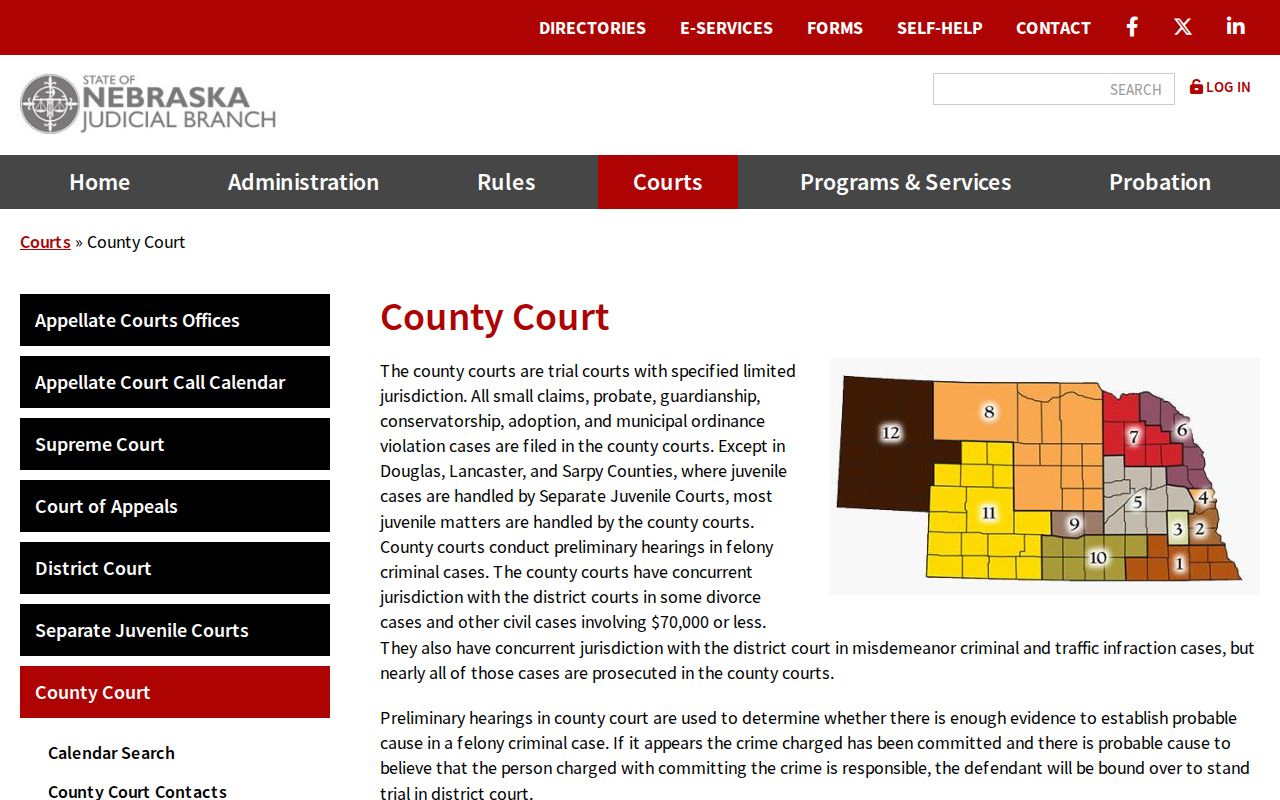
Use that page to orient the court route, then search public JUSTICE case information or contact the county clerk about a particular case. An ordinary Nebraska case starts with the County Court clerk and the sheriff. A focused written records request fits when you need a copy or when an access problem remains. It cannot replace a direct call asking whether a warrant is active today. The court and the serving agency each confirm only the records they maintain. No single office speaks for both, so ask each one what it holds.
Clearing a Nebraska Municipal Warrant
City-ordinance cases route through County Court now, so that court controls a Nebraska warrant in the case. Start with the clerk. Confirm the order, the case number, and the court. Then ask what the judge requires: an appearance, a motion to recall or quash, payment, or another case step. Recall means the issuing judge withdraws the warrant by order. It does not necessarily dismiss the citation or end the case.
- Confirm the current County Court and ask whether the warrant is active, served, or recalled.
- Ask the clerk how to appear or request a hearing and whether a lawyer should file a motion to recall or reset the case.
- If a fine or court cost is due, confirm the balance, accepted payment channel, and whether payment resolves only money due or also triggers a separate court action.
- Ask the sheriff or named city police agency whether it received any recall order and how service status is recorded. Keep written orders and receipts.
Caution: Do not assume a city fine payment or an old court label clears a warrant; get the issuing County Court's order and confirm agency notice.
Nebraska City Warrant Appearance Steps
A missed court date on a Nebraska city citation calls for one phone call first: the County Court clerk. Ask whether a warrant was issued, whether a hearing or motion can reset the case, what bond amount applies, and whether the sheriff was notified of any recall. If you plan to appear voluntarily, check with the court, sheriff, or jail beforehand. Confirm the right location, current intake hours, booking steps, the first appearance, bond options, and any conditions. Every one of those details is local and case-specific in Nebraska, so the clerk's answer beats any general assumption.
A judge, not the clerk, decides whether to recall the warrant and on what release terms. Nebraska courts may grant personal recognizance or a percentage bond, but no fixed dollar figure follows from the phrase "city court warrant." The Citation Information interface and court ePayments handle eligible citation or case payments only; neither confirms an active warrant, and ePayments does not accept bond. Ask the court or the authorized county bond contact where and how an ordered bond can be posted. A lawyer can arrange an appearance, review the court file, and advise whether a motion or proof of compliance fits your Nebraska case. If the warrant stems from an unpaid qualifying fine or costs, ask the court whether Neb. Rev. Stat. §29-2412 applies. It opens an ability-to-pay hearing and possible statutory alternatives in qualifying cases, depending on the judge's findings; it is not an automatic waiver and does not reach every municipal-ordinance or traffic matter. Follow the judge's order and your case facts, not an online guess. Child-support bench-warrant forms run through a separate family-court process and will not search for or recall a city citation. Juvenile records are restricted under Neb. Rev. Stat. §43-2,108, so if a record is juvenile or sealed, contact the issuing court for the proper access route. For the wider Nebraska bench-warrant process, see the companion Bench Warrant Lookup.
- County Court
- Nebraska's trial court for most traffic, ordinance, and misdemeanor cases and felony preliminary hearings.
- Recall
- A judge's order withdrawing a warrant; the underlying case may continue.
- Serving agency
- The sheriff or officer named to execute process and maintain a service record.
- JUSTICE
- Nebraska's statewide public trial-court case information service, not a warrant-clearance search.