
Nebraska Warrant Checks
No public Nebraska portal lists every active warrant in one place. So work from a case. Find the file first, then contact the court that issued the order and the agency serving it. Start with the county tied to your ticket, citation, arrest, or hearing; traffic, misdemeanor, and city-ordinance cases usually sit in County Court, while felony cases may begin there and move to District Court after bindover.
- Gather the person's legal name, spelling variants, date of birth if the office needs it, county, and any citation or case number.
- Use JUSTICE to locate a public County Court or District Court case. Online name search costs $17, returns up to 30 case records, and provides a three-day viewing window; court or listed law-library terminals are free.
- Check the official county sheriff or local police page if it publishes a warrant list. Local sites differ, and a missing entry is not proof that no warrant exists.
- Call the issuing court clerk to ask whether a warrant remains active, what order controls, and what appearance or recall step is required. Ask the sheriff or named officer about service and return status.
- For a record copy, send a focused request to the likely custodian under the Nebraska Public Records Act. For a personal warrant concern, consider speaking with an attorney before acting.
Older paperwork may name a police magistrate or municipal court. Nebraska no longer runs a separate municipal-court tier. City-ordinance cases now go through County Court, and the Browse Counties directory takes you to the county holding the file.
Nebraska Has No Public Warrant-Only Search
Nebraska's statewide public court search finds cases, not warrants. It is a case locator. No official public Nebraska-wide active-warrant search exists, and neither does a statewide outstanding-warrant roster or a State Patrol fugitive list. A hit on the court site can point you to a case and its docket. That answer is local. It cannot certify live warrant status or hand you a formal "no warrant" result. County list pages vary just as much. Some publish name searches. Others want a phone call, a courthouse visit, or a written record request. NCJIS and NCIC stay closed to anyone outside authorized justice agencies. For any Nebraska case, the issuing court controls the order and any recall. A Nebraska sheriff or named local officer answers service questions, and when the county is unknown, identify it from the notice or use the full county directory.
Nebraska's Statewide Warrant System
Nebraska layers its justice information rather than pooling it. No single public warrant database ties the layers together. JUSTICE runs court case management and internal warrant operations. Its public side gives case information. NCJIS serves agencies, NCIC serves law enforcement nationally, and the DMV's citation-compliance suspension hits a driver's license, not an arrest warrant.
| System or office | Public role | Important limit |
|---|---|---|
| JUSTICE | Statewide County and District Court case information | Not a live warrant-only search or status certificate |
| NCJIS | Secure criminal-justice information for agencies | No public search or published warrant coverage map |
| NCIC | National law-enforcement information for authorized users | No public consumer query |
| Nebraska DMV compliance | Traffic-citation suspension and proof-of-compliance process | Not a warrant index or warrant-recall record |
Every warrant stays tied to its issuing case and serving agency. Nebraska State Patrol works statewide. It publishes no public warrant roster. For how the state systems work and where they stop, see the Warrant Database page.
JUSTICE Locates Nebraska Warrant Cases
JUSTICE can locate Nebraska County Court and District Court case information across the state. A one-time party-name search costs $17. It returns up to 30 case records. You get a three-day viewing period. The Judicial Branch reports a 24-hour lag between case entry and online appearance. Access is free at courthouse or listed law-library terminals. Subscriber case-detail views cost $2 under the fee schedule effective Jan. 1, 2026. The docket then shows the case number, court, filings, financial entries, orders, and hearings. That tells you which clerk to call. It does not show whether a Nebraska arrest warrant is active, whether a sheriff has a recall, or that a blank result means no Nebraska warrant exists. Open the Nebraska Judicial Branch Case Information eServices page for current access options.
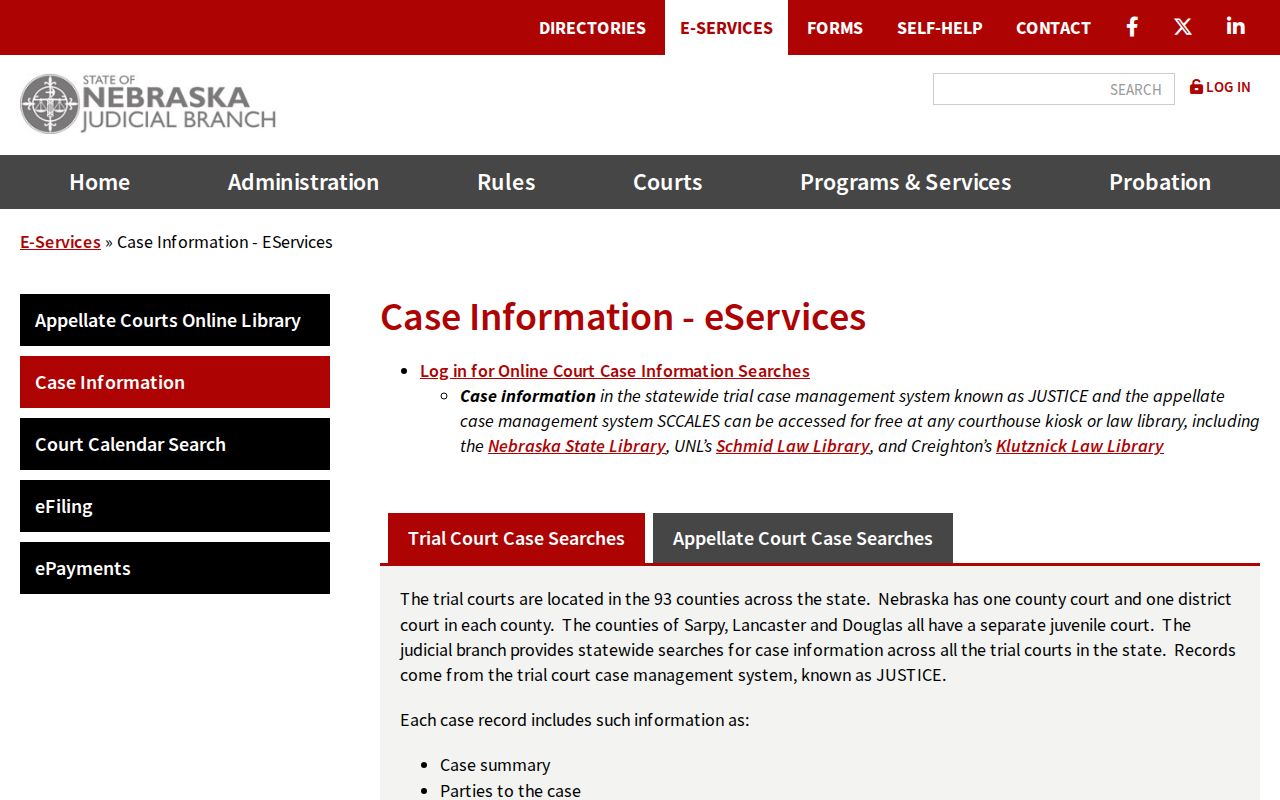
Use a free courthouse terminal instead. Whatever the docket shows, confirm warrant status directly with the issuing Nebraska court and the agency serving the order.
Note: The 24-hour case-entry lag described by the court is not a warrant-service or recall timeline.
Warrants in Nebraska: The Main Types
Nebraska court papers mostly say arrest warrant or bench warrant. The label alone tells you little. What matters is the issuing case, the court order, the serving agency, and current status. Capias and capias pro fine are not statewide terms here, so treat failure-to-appear and unpaid-fine process by what your court calls it.
| Process | How it arises | Who controls the record |
|---|---|---|
| Arrest warrant | A complaint and judicial probable-cause review in a case | Issuing County or District Court; sheriff or named officer serves it |
| Bench warrant | Often a missed appearance or failure to comply with a court requirement | Judge in the existing case; serving agency records service |
| Fine or cost process | A qualifying warrant related to unpaid fine or costs | Issuing court; §29-2412 may provide an ability-to-pay hearing in qualifying cases |
| Search warrant | Judicial order to search for and seize specified property or evidence | Issuing court; application materials remain confidential until execution under §29-817 |
| Federal arrest warrant | Federal criminal proceeding or other authorized federal process | U.S. District Court and U.S. Marshals Service |
A warrant from a missed court date is not a new charge on its own. Search warrants target evidence and property, not a public wanted list. Federal and juvenile matters run separately, under their own courts and access rules.
Nebraska Warrant Terms in Plain Language
Local lists carry local labels. They are not a statewide code system. Nebraska documents no common warrant-row schema or universal warrant-number format, so read each term as the issuing court or list defines it, then confirm with that court.
- FTA
- Failure to appear at a required court date. The court decides the consequence in the case.
- Bench warrant
- A judge's order tied to an existing case, often after a missed date or other noncompliance.
- Recalled
- The court has withdrawn the warrant by order. Ask whether the sheriff received that order.
- Quashed
- The judge has set aside the warrant. The underlying case may continue.
- Returned
- The officer has reported a service result back to court. Local field names vary.
- Bond forfeiture
- Court action on a bond after its conditions are not met, often after a missed appearance.
Hall County's printable report shows labels like WAR and BWA. Its public page does not define them, so do not read them as statewide Nebraska codes.
Nebraska Warrant Records: What They Show
Nebraska publishes no statewide warrant-entry schema. A sheriff's list can drop fields, invent its own labels, or lag behind. Ask the court or sheriff. Fields change, and a report's date may not mean what you think, and a field named "expiry" does not make an unserved warrant expire.
| Warrant number | No statewide format verified; use the case number printed by the issuing court. |
|---|---|
| Subject name | Identity text used by the local record; ask the office if spelling variants need to be checked. |
| Charge or basis | The case offense or court requirement tied to process. |
| Issuing court | County Court for many traffic, misdemeanor, and ordinance matters; District Court for felony trial cases and other district matters. |
| Bond | Amount and type, if set; the judge's order controls the conditions. |
| Status and return | Local service or recall notation; confirm with the court and serving agency. |
Hall County's local report lists fields such as court number, issue date, process type, and charge class. That is one county's format, not a standard Nebraska database layout.
Note: Nebraska has no verified statewide warrant-number format; treat a local field as that custodian's label until the court explains it.
Nebraska Court Filings Do Not Count Warrants
Nebraska runs 93 counties, with 93 County Courts and 93 District Courts spread across 12 judicial districts. That is a lot of courts. In FY2024, County Courts recorded 270,375 adult case filings, including 89,459 traffic cases. Those are workload totals. They measure what clerks processed, not how many warrants are active. Nebraska publishes no statewide active-warrant count. The Nebraska Judicial Branch annual caseload report supplies the adult and traffic figures. Do not convert them into a warrant estimate. A traffic case may end with payment or another disposition, and that alone does not mean a warrant issued. The Judicial Branch also reports 58 District Court judges and 59 County Court judges in its FY2025-27 planning materials. Assignments can cover more than one county. So judge counts do not mean every county has a dedicated judge per case. Read the FY2024 County Court Annual Caseload Report for the underlying court workload totals.
Warrant Record Access Under Nebraska Law
Nebraska's Public Records Act lets you request releasable existing records from the public office that holds them. It creates no statewide warrant search. Nor does it erase confidentiality rules. Court access still follows Nebraska court rules, statutes, and any sealing order. A public case search helps, but no Nebraska court service issues a formal no-warrant certificate.
Access rules:
Neb. Rev. Stat. §84-712 provides public inspection and copy rights, subject to exceptions, and an initial response framework within four business days.
Neb. Rev. Stat. §84-712.05 lists records that may be withheld under statutory exceptions.
Neb. Rev. Stat. §29-817 keeps search-warrant application materials confidential until execution.
Neb. Rev. Stat. §43-2,108 restricts access to juvenile court records.
Focus your Nebraska request on the record itself and the court, sheriff, or police agency most likely to hold it. Name what you want. Within four business days, the office may grant access, deny it with a legal reason, or give an estimate and the earliest practical date. That estimate is not always the final production deadline.
Note: Ask for the releasable part of an existing record; a records request is not an emergency status check or a statewide certificate.
Nebraska's Court Consolidation Changed City Routing
Nebraska built its current County Court system in 1972, after a constitutional and statutory reorganization consolidated local court functions. Before that, justice-of-the-peace and police-magistrate courts handled many matters now routed through County Court. That history matters. An older city paper or local page may still say "municipal court" even though today's case sits with the County Court. Municipal-court employees transferred into the County Court system on July 1, 1985. Dates trip people up. A city may still prosecute an ordinance. City police may still serve a warrant. But no city in Nebraska runs its own municipal-court docket tier. Ask the current clerk for the case number and court that now holds the file. The Nebraska Judicial Branch history timeline describes the consolidation milestones. The change affects routing, not warrant status or database coverage.
Nebraska Courts Warn About Fake Warrant Demands
Nebraska Courts say they never serve arrest warrants by phone, text, or email and never demand payment through those messages. A scammer may borrow court language. A case number can make an urgent demand sound real. Verify first. Do not trust a number inside an unexpected message. Look up the court or sheriff's official contact on your own and ask whether the case exists. The Judicial Branch runs a statewide scam-alert project. It gives the public a place to check suspicious court-related demands. A court's warning is not a warrant search. If a real case needs attention, the issuing clerk and the serving agency can explain the record and your next step. Read Nebraska Courts' scam alert before answering any demand that claims immediate arrest or payment is required.
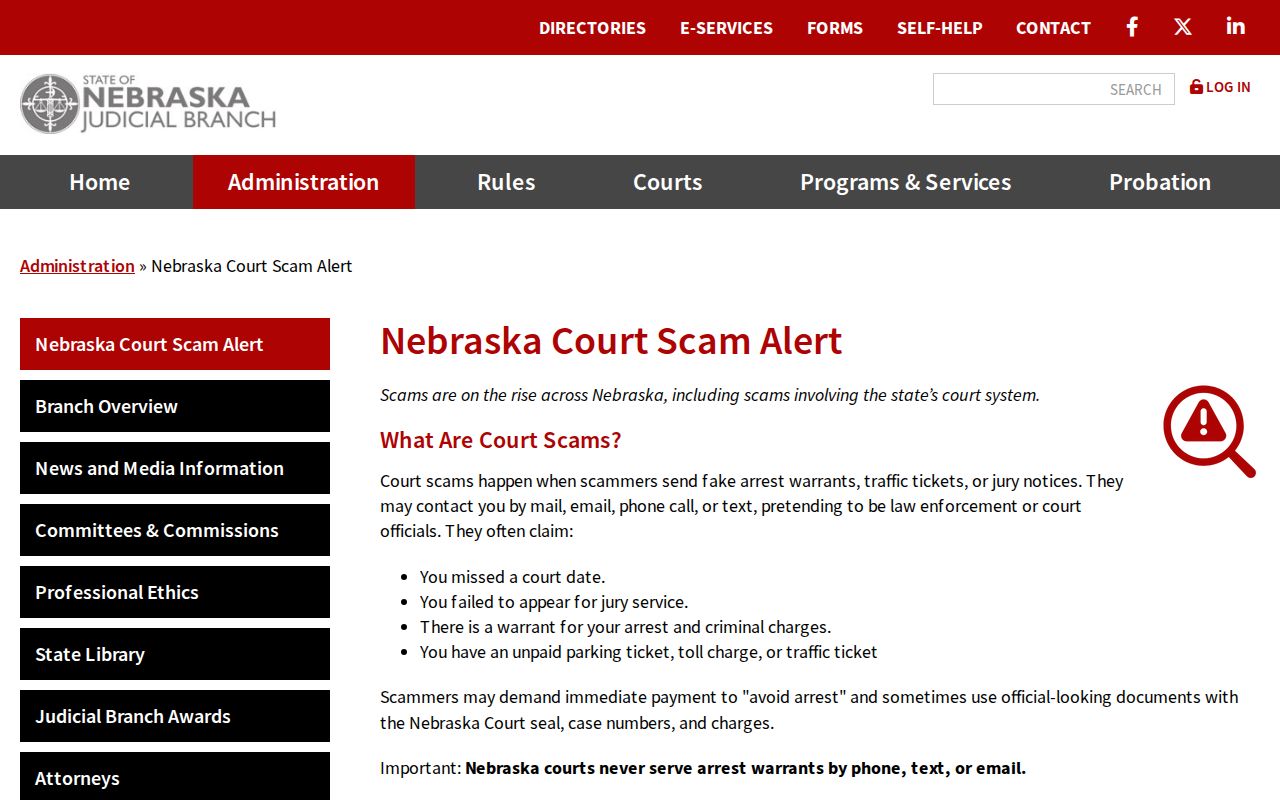
The Nebraska alert shows how official court details can be misused. Use verified contacts, and never reply with money or sensitive data.
Nebraska Traffic Warrants and DMV Holds Differ
In Nebraska, a traffic citation, a court warrant, and a DMV compliance suspension are separate records. A missed date or failure to comply can bring court consequences. Not every unpaid citation becomes a warrant. County Court handles most traffic matters, including city-origin ordinance cases. The DMV's process concerns a driver's license. It does not touch public warrant status.
| Record | What it means | Who can confirm it |
|---|---|---|
| Citation or court case | Traffic matter and its payment or appearance requirements | Issuing County Court |
| Bench or FTA warrant | Court process after a missed appearance or other order | Issuing court and serving sheriff or named officer |
| DMV suspension | License consequence for failure to comply with a citation | Nebraska DMV and the court's compliance record |
The DMV says a $50 reinstatement fee ordinarily applies to qualifying citation suspensions. Payment may take 24 or more hours to post. Electronic compliance goes out the next day after posting. Those are DMV process timings, not a warrant recall deadline, so ask the Nebraska court separately whether process was recalled.
Note: Paying a citation can settle money due while a separate court appearance or warrant recall still needs confirmation.
How to Resolve a Nebraska Warrant
Nebraska publishes no single walk-in surrender point, recall form, or pay-to-lift procedure. The issuing judge controls recall. A sheriff or named officer serves the order. Before you travel or pay anything, locate the case and ask which office handles each step, since a lawyer can explain an appearance, bond, or motion based on the case.
- Use JUSTICE if available to identify the case and issuing court, then call the clerk to ask whether the warrant remains active.
- Ask what order or hearing is required, whether bond was set, and which agency holds or serves the warrant.
- Call the sheriff or jail before appearing. Ask about intake, booking, bond methods, required identification, and any release conditions.
- If a missed date caused the warrant, ask the court about a motion to recall or reset. The judge decides whether to withdraw the order.
- Keep receipts or a written recall order, then ask whether the sheriff received notice and the warrant was returned.
Hall County Court and Grand Island held a one-time Warrant Wipeout Day on Aug. 21, 2026 for eligible local cases. That date has passed. The event was not a statewide Nebraska program. Its official notice listed exclusions, so do not treat it as a general surrender promise. Read the Grand Island event notice for its original scope and date. The notice describes a public event. It is not any person's warrant record.
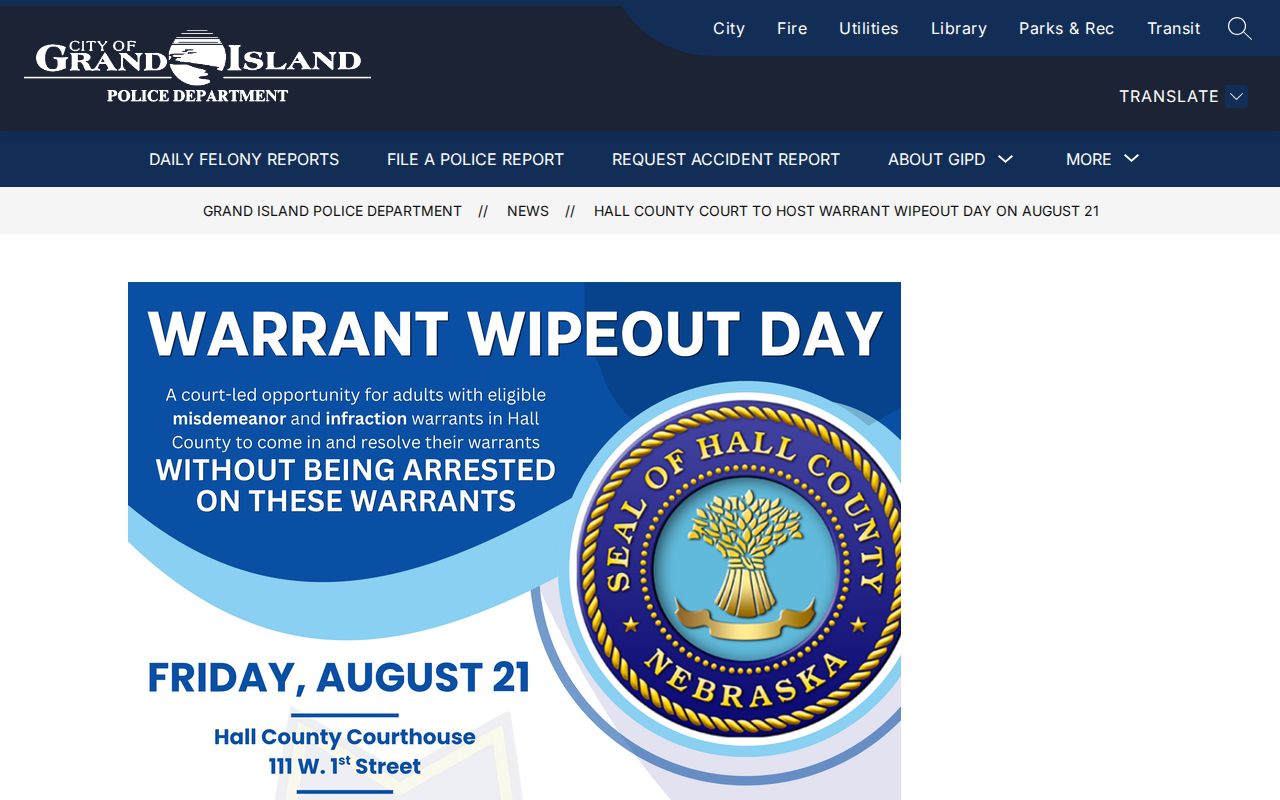
The standard path stays case-specific: contact the issuing Nebraska court and sheriff. No event or payment wipes every separate court, service, or DMV record automatically.
Warrant Records by County in Nebraska
Nebraska keeps each warrant in the county that issued it. The sheriff or another named agency serves the paper. Seven large county routes can point you in the right direction, though the local court still confirms current status. The 2020 Census population counts measure county size, not warrant volume.
Douglas County
Omaha · 584,526 residents in the 2020 Census; Nebraska's largest county by population, with the sheriff on the USMS Metro Area Fugitive Task Force.
Lancaster County
Lincoln · 322,608 residents in the 2020 Census; state capital and home to the state courts, with local police and sheriff channels.
Sarpy County
Papillion · 190,604 residents in the 2020 Census; separate Juvenile Court and searchable local sheriff warrant channel.
Hall County
Grand Island · 62,895 residents in the 2020 Census; local sheriff search and report, plus a past 2026 Warrant Wipeout event.
Buffalo County
Kearney · 50,084 residents in the 2020 Census; County Court for traffic and misdemeanor matters, with the sheriff confirming warrants.
Dodge County
Fremont · 37,167 residents in the 2020 Census; county routing example for the northeast and Platte River area.
Platte County
Columbus · 34,296 residents in the 2020 Census; county seat, with local court and sheriff contacts for status and service.
Nebraska has 93 counties. Open the Browse Counties directory to reach the site for the county that issued the warrant.